How to Identify Hail and Wind Damage on Your Roof
Learn what hail and wind damage actually look like on shingles, metal, and soft materials, what adjusters look for during an inspection, the difference between cosmetic and functional damage, and how to document what you find before you call your insurer.
By Tim DunbarFounder, RoofClaim HQPublished
Hail and wind damage is often less dramatic than people expect. Homeowners picture shattered shingles and obvious holes, but most functional storm damage is subtle: bruised mats, cracked seals, and granule loss that's easy to miss from the ground. Knowing what to actually look for — and what adjusters are trained to look for — is the difference between a claim that gets approved on the first pass and one that gets disputed or denied.
This guide walks through how to spot hail and wind damage on the most common roofing materials, how insurance adjusters evaluate what they find, why the distinction between "cosmetic" and "functional" damage matters so much, and how to build a documentation record before you ever pick up the phone to call your carrier.
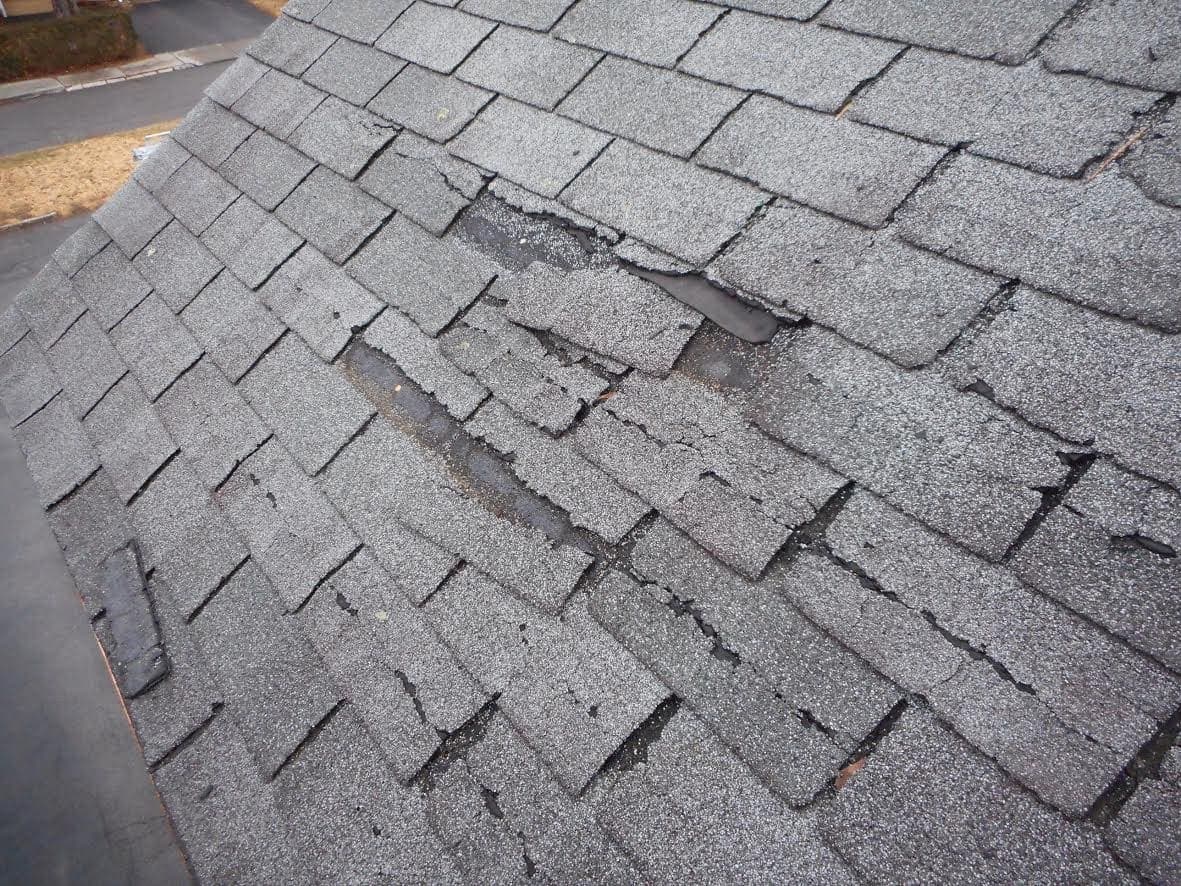
Wind-torn tabs and exposed patches like these are functional damage — the kind adjusters approve. Photo: Sandul1234, CC BY-SA 4.0
What hail damage actually looks like on asphalt shingles
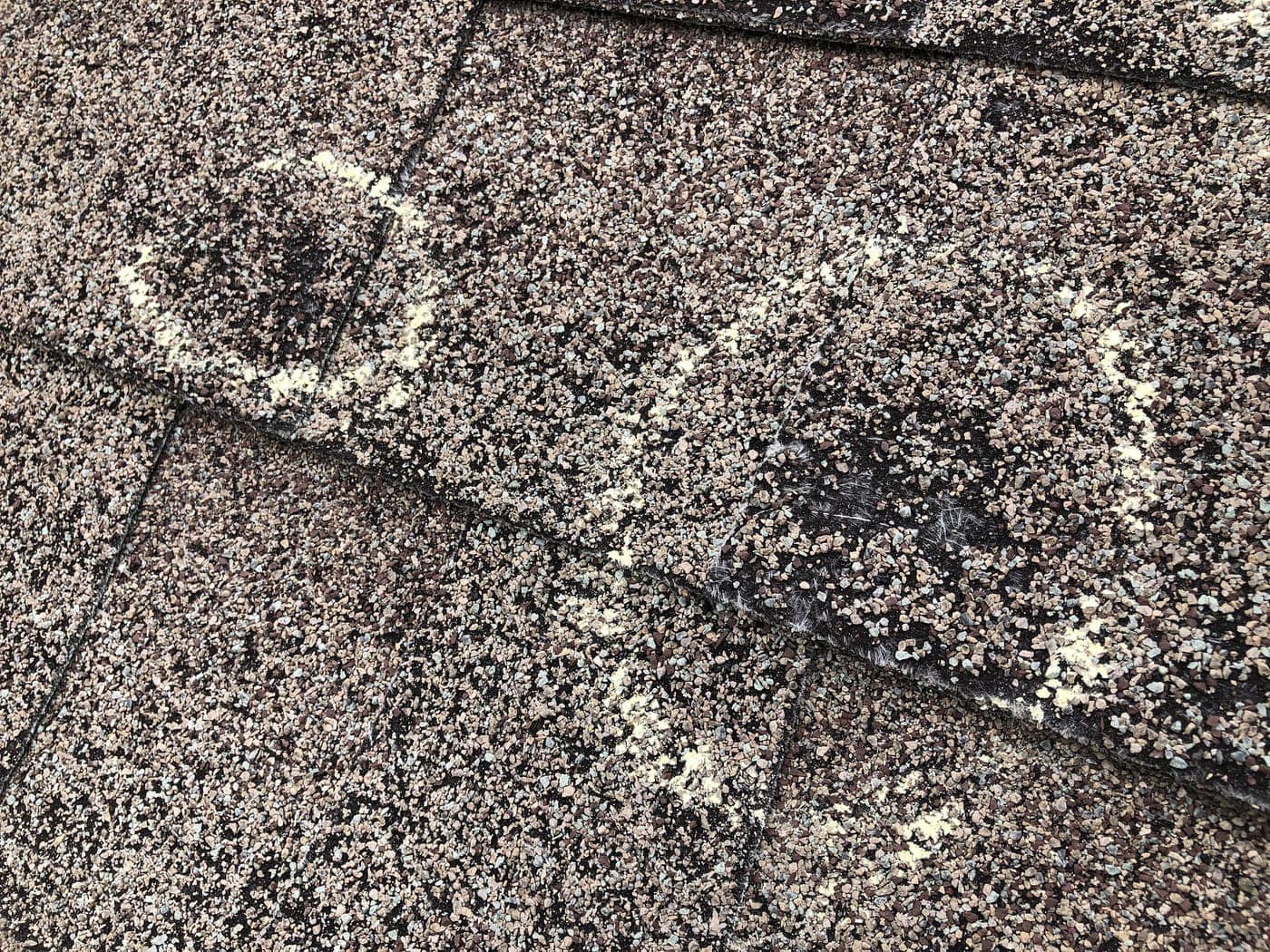
What functional hail damage looks like up close: granules crushed away and the fiberglass mat visibly exposed and fractured. Damage like this shortens the roof's life — it isn't cosmetic. Photo courtesy of Continental Roofing Company, used with permission.
Asphalt shingles are the most common roofing material in the U.S., and they're also the material most people misjudge. Hail damage on shingles rarely looks like a hole. Instead, look for:
- Granule loss. Each shingle is coated in a layer of granules that protects the asphalt underneath from UV light. A hail impact knocks granules loose in a roughly circular pattern. You'll often find them collected at the bottom of downspouts or in gutters after a storm — that's frequently the first sign anything happened.
- Bruising. Underneath the granules, a hail strike can soften or crack the fiberglass mat without breaking through the surface. Pressing gently on a suspected bruise sometimes reveals a slightly spongy or dented feel compared to the surrounding shingle. This is exactly the kind of damage that's invisible from the ground and easy to underestimate.
- Random, scattered pattern. Hail damage tends to be randomly distributed across a slope rather than following a straight line or a single edge — that randomness is one of the things adjusters use to distinguish hail impacts from mechanical damage, foot traffic, or manufacturing defects.
- Exposed fiberglass mat. In more severe impacts, granules and asphalt are knocked away entirely, exposing the black or gray fiberglass mat beneath. This is almost always classified as functional damage because the UV and moisture barrier is compromised.
Wind damage on shingles looks different: creased shingles (bent along a horizontal line without breaking), shingles that are lifted, curled, or missing outright, and shingles with broken or failed adhesive seals along the edges. A crease is a strong indicator of wind damage specifically — hail doesn't crease shingles, it bruises or fractures them.
What hail and wind damage looks like on other roofing materials
- Metal roofing and flashing. Hail dents metal — soft, rounded indentations, often in clusters. On standing-seam or metal shingle roofs, dents are usually cosmetic unless the impact also compromised a seam or fastener, which can affect water tightness.
- Gutters, downspouts, and vents. These are made of relatively soft aluminum and are one of the most reliable places to find corroborating evidence of a hailstorm, even when roof damage itself is hard to see from the ground. Dented gutters alone don't prove roof damage, but they're useful supporting evidence of storm severity.
- Window screens and AC units. Similarly soft materials that often show hail impact clearly. Bent or torn screens and dented AC fins are common corroborating signs.
- Wood shake and tile roofs. Hail can split wood shakes or crack and chip tile. Because these materials are more expensive to replace and harder to patch invisibly, insurers and contractors alike tend to scrutinize damage claims on these roof types more closely.
- Flat and low-slope roofs (membrane, TPO, EPDM). Look for punctures, bruising you can feel as a soft spot, and granule loss on mineral-surfaced cap sheets. Ponding water after a storm can also signal a new low spot caused by impact damage.
Cosmetic damage vs. functional damage
This distinction drives most of the disagreements between homeowners, contractors, and insurers, so it's worth understanding clearly.
Functional damage impairs the roofing material's ability to do its job — keeping water out and protecting the structure underneath. Cracked mats, exposed fiberglass, broken seals, torn shingles, and compromised flashing are functional. Functional damage typically shortens the service life of the roof and, left alone, tends to get worse: a bruise today can become a crack and then a leak over subsequent freeze-thaw cycles or UV exposure.
Cosmetic damage affects appearance without measurably affecting performance. Dents in metal components that don't break the paint seal or compromise a seam are the most common example. Some insurers apply a "cosmetic damage exclusion" specifically to metal roofing and accessories in hail-prone states, meaning a dented-but-still-functional metal roof may not be covered even if hail caused it.
The distinction matters because adjusters are instructed to assess whether damage is functional before recommending replacement or repair. A roof that looks worse but performs the same is a much harder case to make than one with clear evidence of compromised material integrity. This is exactly where a trained eye — whether a contractor, a public adjuster, or an experienced independent adjuster — earns their value: separating what merely looks bad from what will actually fail.
What adjusters look for during an inspection
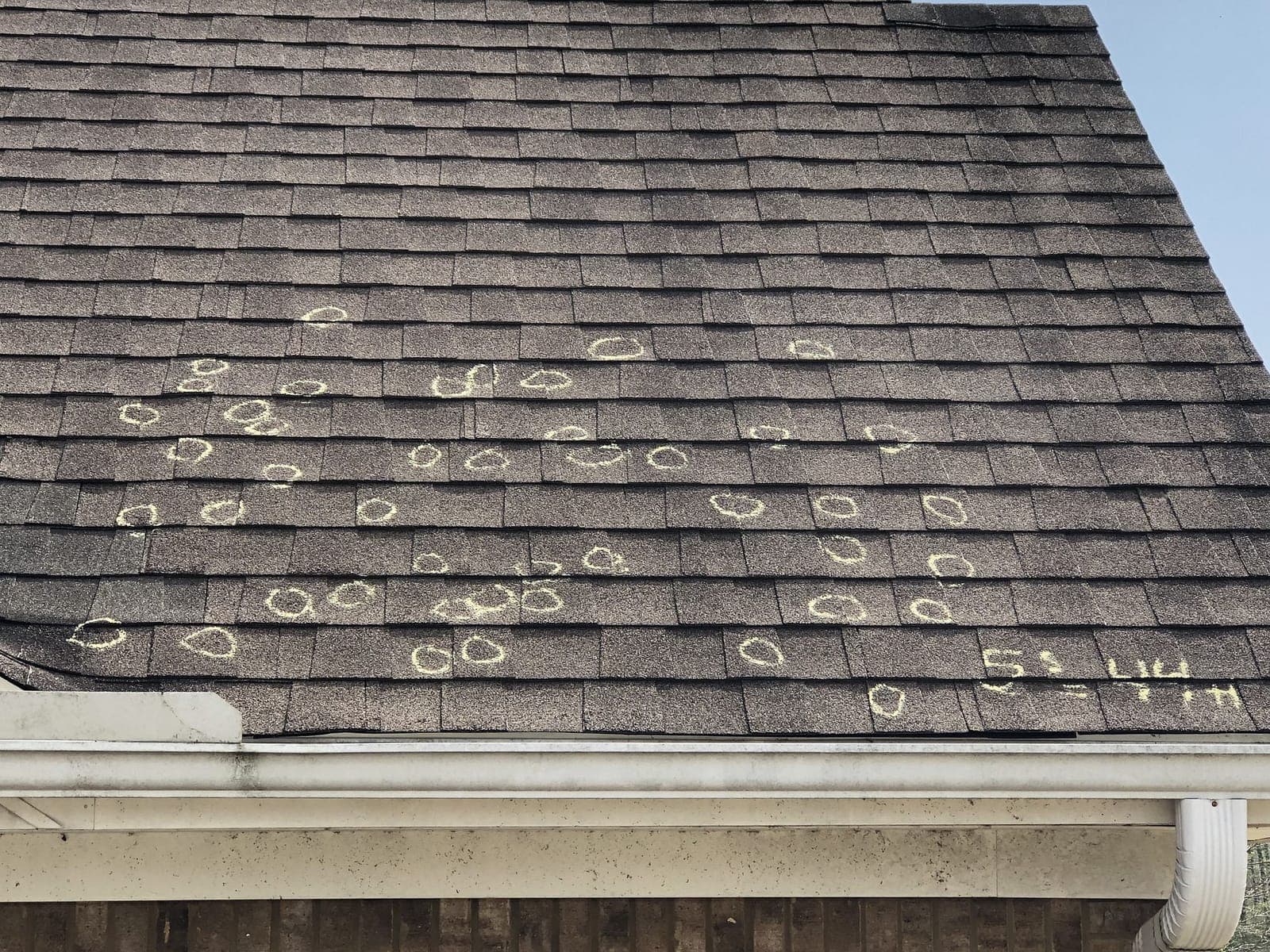
A slope that qualifies, documented the way carriers expect: every strike chalk-circled, with the inspector's tally — 44 hits in a five-foot section — written directly on the roof. Photo courtesy of Continental Roofing Company, used with permission.
Insurance adjusters are trained to test and document damage in a fairly consistent way, regardless of carrier:
- Test squares. On sloped roofs, adjusters typically mark off a 10-foot-by-10-foot test square on each slope and count hail hits within it. Most carriers use a threshold — often around 8 hits per test square, though this varies by carrier and roof type — to determine whether a slope shows a "damageable" pattern versus isolated, incidental hits.
- Random vs. patterned distribution. As noted above, adjusters look for damage that's randomly scattered rather than concentrated in one area, which would suggest a different cause (falling debris, foot traffic, an existing defect).
- Soft metal cross-reference. Adjusters commonly check gutters, vents, and AC units alongside the roof itself, because dented soft metal supports the theory that hail large enough to damage the roof actually occurred, even where the visual roof evidence is more ambiguous.
- Age and pre-existing condition of the roof. Adjusters will factor in how old the roof is and whether wear, prior repairs, or poor installation could explain what they're seeing instead of the storm. This is one of the most common points of dispute — see our guide on working with an adjuster for how to prepare for it.
- Slope-by-slope documentation. Because hail direction and intensity can vary by which way a slope faces relative to the storm, adjusters typically photograph and assess each slope separately rather than assuming uniform damage across the whole roof.
Building your own documentation before you call
Whether or not you end up filing a claim, documenting what you find protects you. Do this as soon as it's safe to get on or near the roof:
- Photograph every slope from the ground first, then from a ladder or with a zoom lens if you can safely get closer. Wide shots establish context; close-ups establish detail.
- Photograph gutters, downspouts, vents, screens, and any AC or HVAC equipment for corroborating soft-metal damage.
- Note the date of the storm, and if possible, find independent confirmation it occurred — local news coverage, a National Weather Service storm report, or a neighbor's account. This becomes useful if your filing date is questioned later.
- Photograph interior ceilings and attic spaces for any sign of water intrusion, staining, or daylight visible through the roof deck.
- Keep a written log with dates: when you noticed damage, when you photographed it, when you contacted your insurer, and any names of people you spoke with.
- Avoid roof work or repairs before documenting, other than emergency tarping to prevent further water intrusion, which most policies do require you to do and will reimburse.
- Don't sign anything with a contractor — including a "certificate of completion," assignment of benefits, or work authorization — before you've documented damage yourself and ideally before your insurer has seen it. See our guide on choosing a roofer for how to vet a contractor before signing anything.
Roof age, wear, and how it complicates an assessment
One of the most common sources of disagreement in a hail claim isn't whether hail hit the roof — it's whether what you're looking at was caused by that storm or was already there. Asphalt shingles lose granules and become more brittle simply through normal aging and UV exposure, and a roof nearing the end of its expected service life can show wear that superficially resembles impact damage: scattered granule thinning, minor cracking, and curling edges. This is exactly why adjusters look for the randomly scattered pattern described above rather than relying on granule loss alone — age-related wear tends to be more uniform across a slope, while impact damage tends to be scattered and inconsistent in a way that correlates with a specific event.
This doesn't mean an older roof can't have a valid hail claim. It means the evidence needs to work harder: soft-metal corroboration, a documented storm date, and, ideally, a professional assessment that can speak specifically to the difference between wear and impact on your particular roofing material and its age. If your roof is older, it's worth being upfront about that rather than treating it as something to hide — a straightforward claim that acknowledges the roof's age and still demonstrates specific storm-caused damage tends to move more smoothly than one that avoids the subject.
Timing your inspection after a storm
Getting on or near the roof safely, ideally within a few days of a suspected storm, has real advantages: debris and granule accumulation in gutters is freshest and most attributable to the recent event, any temporary tarping needs are more obvious, and your own memory of the timeline is sharpest. That said, don't rush a physical roof inspection if conditions are unsafe — wet, icy, or steep roofs are a common source of fall injuries, and a ladder-and-binoculars or zoom-lens approach from the ground is a reasonable substitute for your own preliminary check. Leave the on-roof walkthrough itself to a professional if you have any doubts about doing it safely.
Once you've got your own documentation, you're in a much stronger position to move into the filing process itself, covered in detail in our guide to filing a claim step by step.
Not sure where your claim stands?
Describe the damage once and local roofing contractors can inspect it and give you an estimate.
Frequently asked questions
No. Granule loss and mat bruising can be subtle enough that you don't notice them from the ground, and some damage only becomes obvious months later when a bruised spot finally cracks or a leak develops. That's part of why insurers set filing deadlines rather than requiring immediate discovery — but it also means it's worth a proactive inspection after any significant hail or wind event, even if nothing looks obviously wrong.