My Insurer Valued My Hail Damage at $242. My Deductible Was $2,500.
My adjuster said there was "absolutely no hail damage." His own estimate said $242.28 — against a $2,500 deductible. Those are two different denials, and only one of them is worth fighting.
By Tim DunbarFounder, RoofClaim HQPublished
For four months I thought I was arguing about whether my roof had hail damage. I was actually arguing about $2,257.72.
That number is the gap between what my insurer's own estimate said the damage was worth — $242.28 — and my policy's wind and hail deductible of $2,500. I did not learn it from the adjuster, who told me on the phone that the inspection found "absolutely no hail damage." I learned it months later, reading the carrier's own paperwork in my claim file.
Those are two different denials, and I spent months answering the wrong one.
The two things "denied" can mean
When a carrier closes a roof claim with no payment, it is almost always one of two situations, and they look identical from your kitchen table:
- No covered damage was found. The carrier says the loss you reported did not happen, or is not the kind of thing your policy covers — wear, age, manufacturing defect, or damage from an event outside the policy period.
- Damage was found and valued below your deductible. The carrier agrees something happened. It priced the repair, the price came in under your deductible, and so there is nothing to pay.
The second one is not, strictly speaking, a denial. Nobody denied coverage. But the letter closes your claim, the payment is zero, and in most cases the claim is still reported to CLUE, so it can follow you to your next policy anyway.
The reason the distinction matters is that the two require completely different responses. Fighting the first means proving damage exists. Fighting the second means proving the price is wrong. Evidence that wins one does almost nothing for the other.
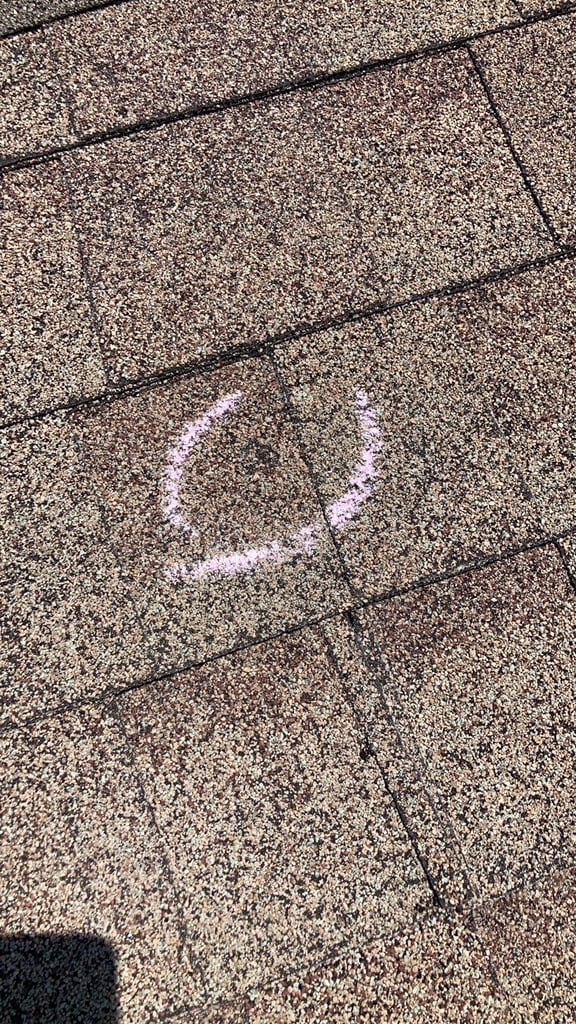
This is what the carrier priced at $242.28 across the whole roof. Photo courtesy of Yellowhammer Roofing, from the author's own denied hail claim.
What my file actually said
Three roofing contractors inspected my roof after a March 2023 hail storm and all three said it needed replacement. One counted 44 hail strikes in a single five-foot section on the left slope and 41 on the right, and photographed shingles with the granules gone and the fiberglass mat exposed.
My carrier's paperwork told a different story, and told it inconsistently:
- The estimate of loss put the replacement cost value of the storm damage at $242.28.
- The deductible was $2,500.
- A revised estimate five months later raised the figure to $637.41 — still nowhere near the threshold.
- Meanwhile the adjuster's verbal position, and one of the two letters I received, was that there was no hail damage at all.
Look at what that combination does. If the damage is worth $242.28, then damage exists — you cannot price something at $242.28 and simultaneously hold that it is not there. The estimate quietly concedes the very thing the phone call denied.
I could not have made that argument in April, because I had not seen the estimate. I was busy sending more photographs to prove damage existed, which was never really the disputed question.
Why the estimate is the document to ask for
Most homeowners ask for "the inspection report," get refused, and stop. That was my mistake for several weeks. The inspection report is the third-party vendor's findings and carriers guard it. The estimate is a different document — the itemised valuation, usually generated in Xactimate — and it is far more commonly shared, because in a normal claim the carrier has to send it to you anyway.
Ask for it by name. "Please send the estimate of loss for this claim, including all line items," in writing, is a different request from "please send me the inspection," and it succeeds more often.
What you are looking for when it arrives:
- The total, next to your deductible. This tells you which of the two denials you are actually in.
- What is missing. Underlayment, ice-and-water shield, drip edge, starter course, ridge cap, flashing, and detach-and-reset of vents and satellite mounts are routinely left out. On a marginal claim, those omissions are often the entire gap.
- The measurements. Squares, ridge and hip lengths, and pitch. If the carrier used an aerial measurement service and the numbers are low, the price is low for that reason alone.
- The date. A revised estimate means someone re-examined the file, which is useful to know.
What to do with a below-deductible number
If the estimate concedes damage and simply prices it too low, you are in a valuation dispute, which is a better position than a coverage dispute. Three things follow from that.
Get a line-item comparison. Ask your contractor for an itemised estimate in the same format, not a single replacement price. Two totals that differ prove nothing; two line-item lists that differ show exactly where and by how much, and that comparison is what a supplement request is built from.
Check the appraisal clause. Most homeowners policies contain one, and it exists specifically for disagreements about the amount of loss — which is precisely what a below-deductible closure is. It is not available for pure coverage disputes, which is one more reason the distinction matters. Read the terms before invoking it: each side pays its own appraiser, and the outcome may be binding.
Escalate in writing, with the estimate attached. Point at the carrier's own number and the specific line items you say are missing. Vagueness gets a form letter; "your estimate omits drip edge, starter, and ridge cap on a 24-square roof" gets an adjuster to open the file.
The part I got wrong
For two months I sent more photographs. More circled hits, more counted strikes, more slopes. It felt like the obvious response to "we found no damage," and it did eventually get the carrier to send a second inspector.
But nobody at the carrier was really disputing that hail hit my house. They had priced it. The number was just small enough that they never had to argue the point, and small enough that no letter had to survive scrutiny — because a claim closed under the deductible produces no payment to justify.
If I had asked for the estimate in April instead of October, I would have spent those two months arguing about scope and price, with a contractor's line-item estimate in hand, instead of proving something my carrier's own paperwork had already conceded.
Ask for the estimate early. It tells you which fight you are in.
Go deeper
Claim Denied? How to Read the Letter and AppealCommon reasons roof claims get denied, how to request a reinspection, how to write a rebuttal, the appraisal clause, and when to file a state complaint.
Not sure where your claim stands?
Describe the damage once and local roofing contractors can inspect it and give you an estimate.
Frequently asked questions
Not technically, but the outcome is identical: no payment, claim closed. The difference matters because the arguments are different. A denial for "no damage" is a fight about whether damage exists. A below-deductible closure concedes damage exists and is a fight about what it is worth. Valuation disputes have a specific tool built into most policies — the appraisal clause — that coverage disputes often do not.