What If the Insurance Check Is Less Than the Roofer's Estimate?
A first check that falls short is usually not a denial. There are three reasons for the gap, only one of them is a real dispute, and telling them apart decides whether you file a supplement or an appeal.
By Tim DunbarFounder, RoofClaim HQPublished
The adjuster's settlement came in at $9,000. Your roofer's estimate says $16,000. That gap is normal and usually isn't a denial — the first check on most policies is the depreciated value, and the rest arrives later. Before you argue, find out which of three things you're looking at.
First, check whether it's a holdback
On a replacement cost policy, the initial payment is the actual cash value: the settlement minus depreciation for the age and wear of the roof. The withheld portion — recoverable depreciation — is released after the work is completed and you submit proof.
So a check that looks like it's missing 40% of the job may be missing exactly nothing. Look at the estimate for a line labeled depreciation, recoverable depreciation, or ACV. If the total settlement roughly matches your roofer's number and only the check is short, the money exists and the sequence is normal.
Subtract the deductible too. Between depreciation and deductible, a first check on a $16,000 job can easily arrive at half that and still be entirely correct. How ACV and RCV work is the background worth having.
Second, look for missing line items
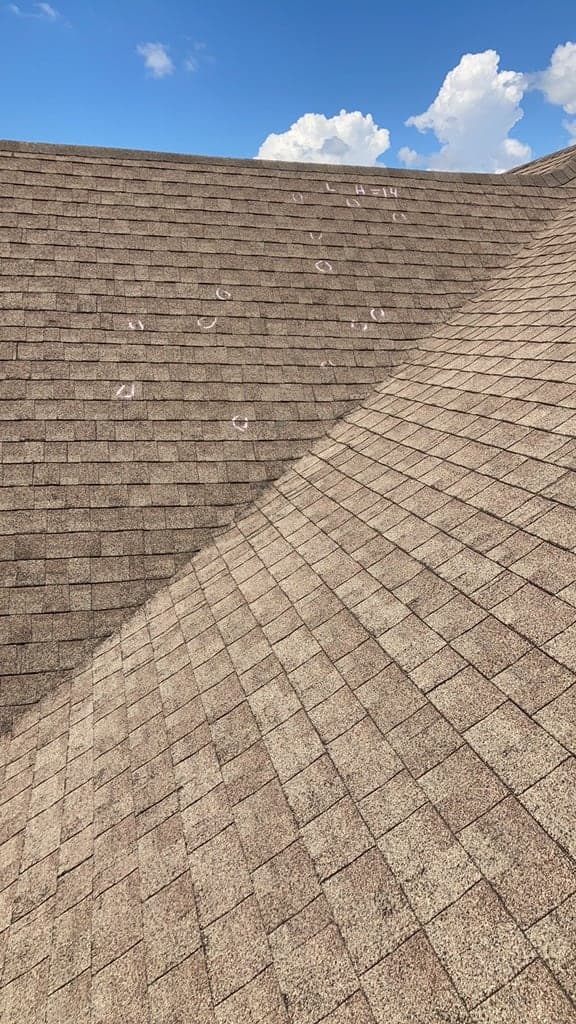
A whole slope marked hit by hit. When a settlement comes in short, the argument is usually about how much of this got counted. Photo courtesy of Yellowhammer Roofing, from the author's own denied hail claim.
If the settlement total is genuinely below the estimate, the usual cause is scope omission rather than disagreement. Adjusters work fast, especially during storm surges, and things get left out:
- Underlayment, ice-and-water shield, drip edge, starter and ridge cap
- Steep-pitch or multi-story labor charges
- Decking replacement that isn't visible until tear-off
- Detach-and-reset for solar, satellite, or gutters
- Debris disposal, permits, and code-required upgrades
- Ventilation components and flashing
None of these are contested — they're forgotten. The remedy is a supplement: your roofer submits the omitted items with photographs, measurements, and code citations, and the carrier issues a revised estimate. This is a routine administrative process, not a fight, and it resolves the large majority of gaps.
Third, the real dispute
Sometimes the carrier has seen the same roof and reached a different conclusion: spot repair instead of full replacement, three slopes instead of four, no matching obligation for a discontinued shingle.
That is a genuine scope disagreement and it needs the appeal route, not a supplement. Note the distinction from a related situation: if the carrier says there's no damage at all while your roofer says there is, that's a different problem with a different playbook. Here, both sides agree damage exists — they disagree about how much work it takes to fix.
How to tell them apart in ten minutes
Request the carrier's full itemized estimate, not the summary page. Then put it beside your roofer's estimate and check, in order:
- Is there a depreciation line? Add it back. Does the total now approximate your roofer's figure? → holdback, no action needed beyond finishing the work.
- Are line items simply absent from the carrier's estimate that appear on your roofer's? → supplement.
- Are the same items present at materially different quantities or unit prices? → scope dispute, and the appeal ladder.
Most homeowners who think they've been underpaid are in category one or two.
What gets supplements approved
Documentation, not persistence:
- Photographs tied to specific line items, not a general album
- Measurements and slope counts
- The manufacturer's installation requirements where they force a method
- Local code citations for anything required by code
- Written explanation of why each item is necessary
Submit it as a package with a clear cover summary. Vague requests to reconsider get slow responses; itemized submissions with evidence get revised estimates.
Don't sign the contract before you know
The expensive mistake is committing to a contract at your roofer's number while assuming insurance will cover all of it. Until the scope is settled, you don't know what the carrier is paying. Agree with your contractor in writing that the work and price track the approved scope plus any supplement — and be careful with leftover funds if the settlement lands above the final cost.
The decision in one list
- Get the carrier's full itemized estimate.
- Add depreciation back and subtract the deductible. Gap explained? → finish the work, submit proof, collect the holdback.
- Items missing entirely? → supplement, with photographs and measurements.
- Same items, different scope or quantities? → written appeal, then independent adjuster or appraisal, then the state regulator.
- Don't sign a contract for a scope the carrier hasn't approved.
Go deeper
Claim Denied? How to Read the Letter and AppealCommon reasons roof claims get denied, how to request a reinspection, how to write a rebuttal, the appraisal clause, and when to file a state complaint.
Not sure where your claim stands?
Describe the damage once and local roofing contractors can inspect it and give you an estimate.
Frequently asked questions
Usually your roofer prepares it, because the supporting material is contractor work — line items, measurements, photographs, and code citations. The claim is still yours, so you stay copied on everything and you approve what gets submitted. Be cautious about handing over the claim entirely: in some states, unlicensed people negotiating claims on a homeowner's behalf is prohibited.