Should I Have a Roofer Inspect the Roof Before I File a Claim?
Yes — and the reason is narrower than most advice suggests. An inspection tells you whether the damage clears your deductible, which is the single fact that decides whether filing makes sense at all.
By Tim DunbarFounder, RoofClaim HQPublished
There's damage up there and you're deciding whether to call your insurer. Call a roofer first. A free inspection tells you whether the damage clears your deductible — and that single number decides whether filing makes any sense.
The order matters more than the inspection does
Here's the asymmetry that drives everything: a contractor inspection costs you nothing and creates no record anywhere. A call to your carrier's claims line can generate a claim record before you've decided to file — sometimes logged as a closed-without-payment claim that still shows up in your history for years.
So you can gather information for free, or you can gather it at the price of a claim record. There's no reason to choose the second.
General questions about your coverage go to your agent. The claims line is for claims you've already committed to filing.
What you're actually buying with the inspection
One fact: which side of your deductible the damage falls on.
Whether to file or pay out of pocket is arithmetic, and you cannot do the arithmetic without a number. Your declarations page supplies the deductible. The roofer supplies the estimate. Everything else follows.
A competent inspection also answers a question you can't answer from the ground — whether the visible damage is the whole damage. Wind that tears off shingles usually creases many more that haven't failed yet. Hail bruising frequently doesn't show from a driveway at all. A patch that looks like a $700 repair can turn out to be a replacement argument, and that changes the decision completely.
What a real inspection produces
Not a verbal opinion. Ask for:
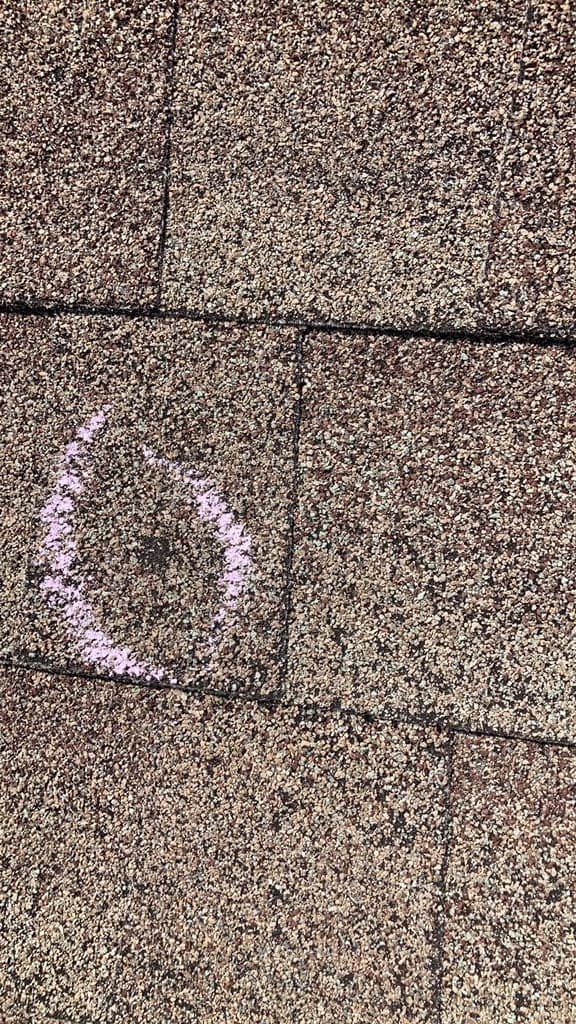
One hit, circled and photographed on its own. This is what documented damage looks like, as opposed to a roofer telling you the roof is bad. Photo courtesy of Yellowhammer Roofing, from the author's own denied hail claim.
- Photographs of every slope, not just the damaged one.
- Collateral evidence — gutters, downspouts, vents, screens, and other soft metal. Denting on those surfaces is often what establishes that a hail event happened at all.
- A written estimate with line items, not a single number on the back of a card.
- A plain statement of what they found and didn't find, including the age and general condition of the roof.
That package is what you use to decide. If you do file, it's also the documentation the claim runs on, and having it before the adjuster arrives puts you in a considerably stronger position.
Who you let on the roof
After a significant storm, your neighborhood fills with contractors, and they are not equally trustworthy. The warning signs:
- They knocked on your door and you'd never heard of them.
- They offer to cover, waive, or absorb your deductible. In many states this is a crime, not a discount — and it is a bad trade even where it isn't.
- They want to inspect before you've hired anyone and then handle the claim for you.
- They push you to sign anything on the first visit, especially a contingency agreement tied to claim approval.
- No verifiable local address, license, or history you can check independently.
How to choose a roofer covers the full screen. The short version: established local companies with a physical address and a history you can verify.
When to skip straight to filing
The inspection-first rule has exceptions. If water is actively coming in, if a tree is on the roof, or if the damage is plainly catastrophic, file immediately — the deductible question is already answered and the delay costs you. Do emergency tarping to prevent further damage, and keep every receipt.
The sequence in one list
- Photograph what you can see safely from the ground, with dates.
- Pull your declarations page and find your wind/hail deductible.
- Get a free inspection and written estimate from an established local roofer — two if the result is borderline.
- Compare the estimate against the deductible and run the decision.
- Filing → file properly with the documentation already in hand, and expect the adjuster within a couple of weeks.
- Not filing → pay for the repair, keep the invoice and photographs. That paper trail protects your next claim.
Go deeper
How to Choose a Legitimate Roofing ContractorStorm chasers and deductible waivers, what a real contract includes, how to verify licensing and insurance, warranties, and payment schedules.
Not sure where your claim stands?
Describe the damage once and local roofing contractors can inspect it and give you an estimate.
Frequently asked questions
Genuinely free is normal — the contractor is bidding for the repair work and treats the inspection as the cost of the sale. The catch isn't a hidden fee, it's a sales incentive: a roofer who only earns money if you file has a reason to find damage. That's why the useful output is documentation you can evaluate, not a verbal opinion, and why a second look is worth the time on a borderline roof.