Partial Repair vs. Full Replacement: The Shingle-Matching Problem
Insurers prefer to patch one slope; homeowners end up with a two-tone roof. Whether you can force a full replacement usually comes down to discontinued shingles, matching rules, and how you argue it.
By Tim DunbarFounder, RoofClaim HQPublished
The adjuster approved repairs to the west slope — twenty squares of brand-new shingles next to fifteen years of weathered ones, in a color that hasn't been manufactured since 2015. Your roof will work fine and look terrible. Do you have to accept that?
Sometimes no — and the difference is usually decided by documentation you can gather in a week.
Why insurers prefer partial repairs
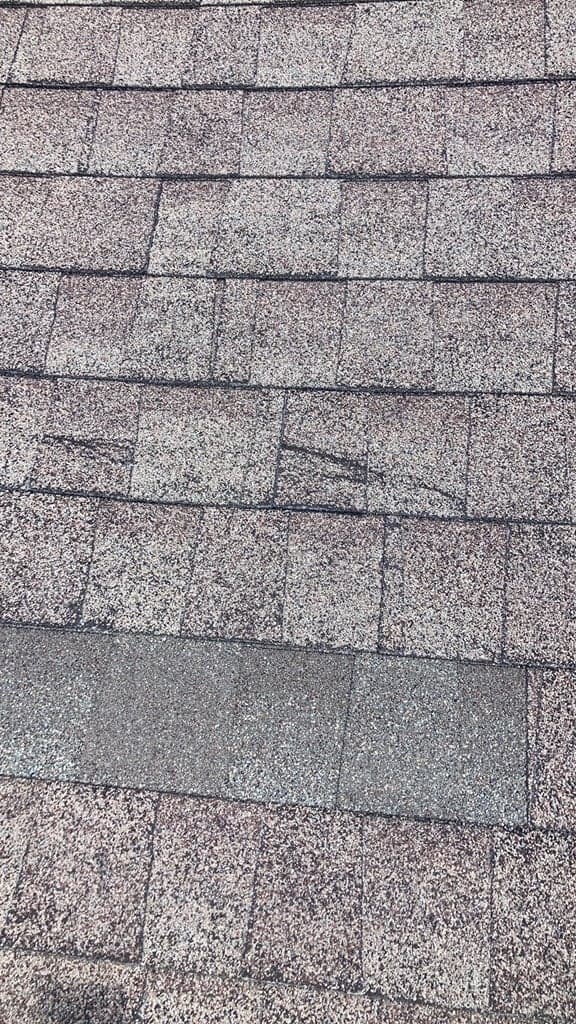
Weathering varies course to course on a roof this age. It is why a patch of new shingles rarely disappears into an old field. Photo courtesy of Yellowhammer Roofing, from the author's own denied hail claim.
Your policy promises to repair or replace damaged portions with material of "like kind and quality." If hail only qualified on one slope, the carrier's default position is to pay for that slope. It's not inherently unreasonable — the dispute is entirely about what happens when a true repair isn't actually possible.
The three questions that decide these disputes
1. Can your shingle still be matched? Shingle lines are discontinued constantly, and weathering means even the same product in the same color won't match your fifteen-year-old field. The standard way to settle this is an ITEL report — an independent lab analysis of a sample from your roof stating whether a reasonable match exists. No match available, and "repair with like kind and quality" becomes impossible as written — which is the opening for a slope or full replacement argument.
2. What does your state say? Matching rules vary widely: some states require a reasonable match and can extend replacement to undamaged areas (sometimes on a "line of sight" standard), others have regulatory guidance short of a statute, and many leave it to policy language. Minnesota is the clearest matching state in the country, and Iowa has given matching disputes real regulatory attention. This is genuinely state-specific — check your state's Department of Insurance guidance.
3. What does your policy say? Some policies now carry explicit matching limitations or exclusions; others offer matching coverage by endorsement. The loss settlement section of your policy — not the adjuster's first-pass position — is the controlling text.
How to argue it
- Get the ITEL report (your roofer can pull the sample) or at minimum written documentation from suppliers that the shingle is discontinued.
- Photograph the mismatch case: your existing shingle, the closest available product, the affected slopes from the street.
- Submit a written request citing the like-kind-and-quality language, the ITEL result, and any state matching rule — this is effectively a scope supplement, and it's a normal one.
- Escalate if refused: reinspection, the appraisal clause (well suited to scope-of-repair valuation disputes), or a Department of Insurance complaint — the standard appeal ladder.
Two cautions
Matching arguments are legitimate; manufactured ones aren't. A contractor promising to "turn every patch into a full roof" regardless of facts is steering you toward the same trouble as the deductible-waiver crowd.
And keep perspective on value: a mismatch isn't only cosmetic — it's a documented hit to resale appeal — but if a match genuinely exists and the repair is sound, taking the repair and moving on is often the right call. Save the fight for roofs where the mismatch is real.
Go deeper
Understanding Your Homeowners Policy: A Plain-English GuideACV vs. RCV, recoverable depreciation, wind/hail deductibles, matching, ordinance and law coverage, exclusions, and a glossary of policy terms.
Not sure where your claim stands?
Describe the damage once and local roofing contractors can inspect it and give you an estimate.
Frequently asked questions
ITEL is an independent lab that carriers and contractors use to identify a shingle sample and report whether a matching product is still manufactured and available. A shingle sample from your roof is mailed in; the report either names available matches or documents that the product is discontinued with no reasonable match. A "no match available" ITEL report is one of the strongest documents you can have when arguing a partial repair should become a slope or full replacement.