I Did Everything Right and My Hail Claim Was Still Denied: A Case Study
Three roofing contractors documented significant hail damage on my roof. My insurer's two inspections found "absolutely none." This is the full, dated timeline of my own denied claim — what worked, what didn't, and what I'd do differently.
By Tim DunbarFounder, RoofClaim HQPublished
Every guide on this site tells you the process can be fought and sometimes won. This article is about the other outcome. In 2023, I went through a hail damage claim on my own roof in North Alabama — with three licensed roofing contractors documenting significant damage — and my insurer, Allstate, denied it. Twice. Then upheld the denial after a state complaint.
I'm publishing the timeline, with the actual inspection photos, because this is the version of the story nobody in the roofing world tells you: what it looks like when you do the right things and the answer is still no. Everything below is drawn from my own dated records, including the complaint I filed with the Alabama Department of Insurance. The factual events are documented; where I state a conclusion, it's my opinion as the policyholder who lived it.
The storm and the damage
A major hail storm crossed our area on March 3, 2023. In the weeks after, I had roofing contractors out to look at the roof, and every one of them reached the same conclusion: significant, functional hail damage; the roof needed replacement.
This wasn't a vague "yeah, looks rough." The first contractor's assessment chalk-circled every strike and wrote the tally directly on the roof:
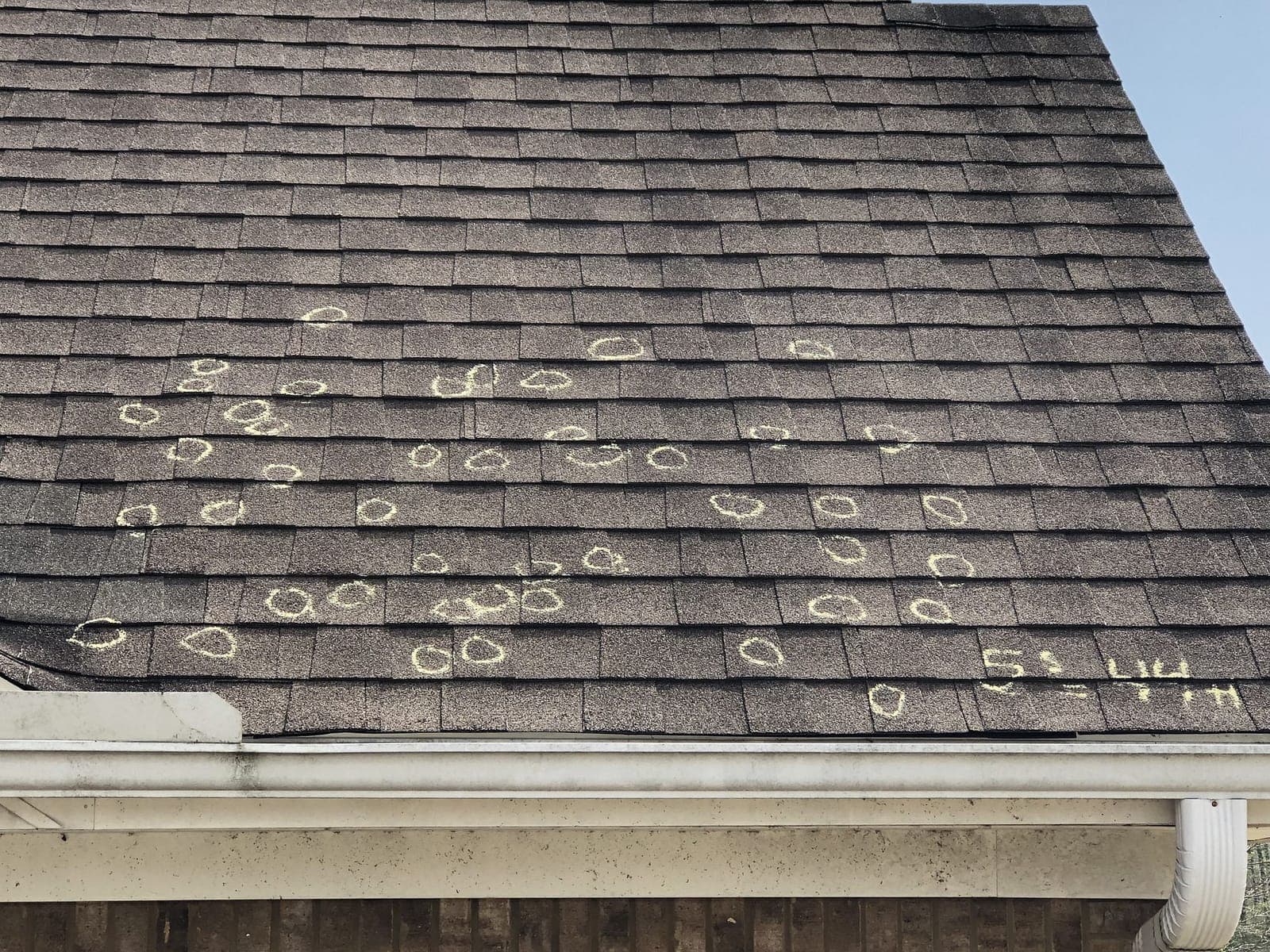
Forty-four hits in a five-foot section, circled one by one. Photo courtesy of Continental Roofing Company.
Up close, the strikes showed crushed granules and exposed, fractured fiberglass mat — the textbook definition of functional damage, the kind that shortens a roof's life:
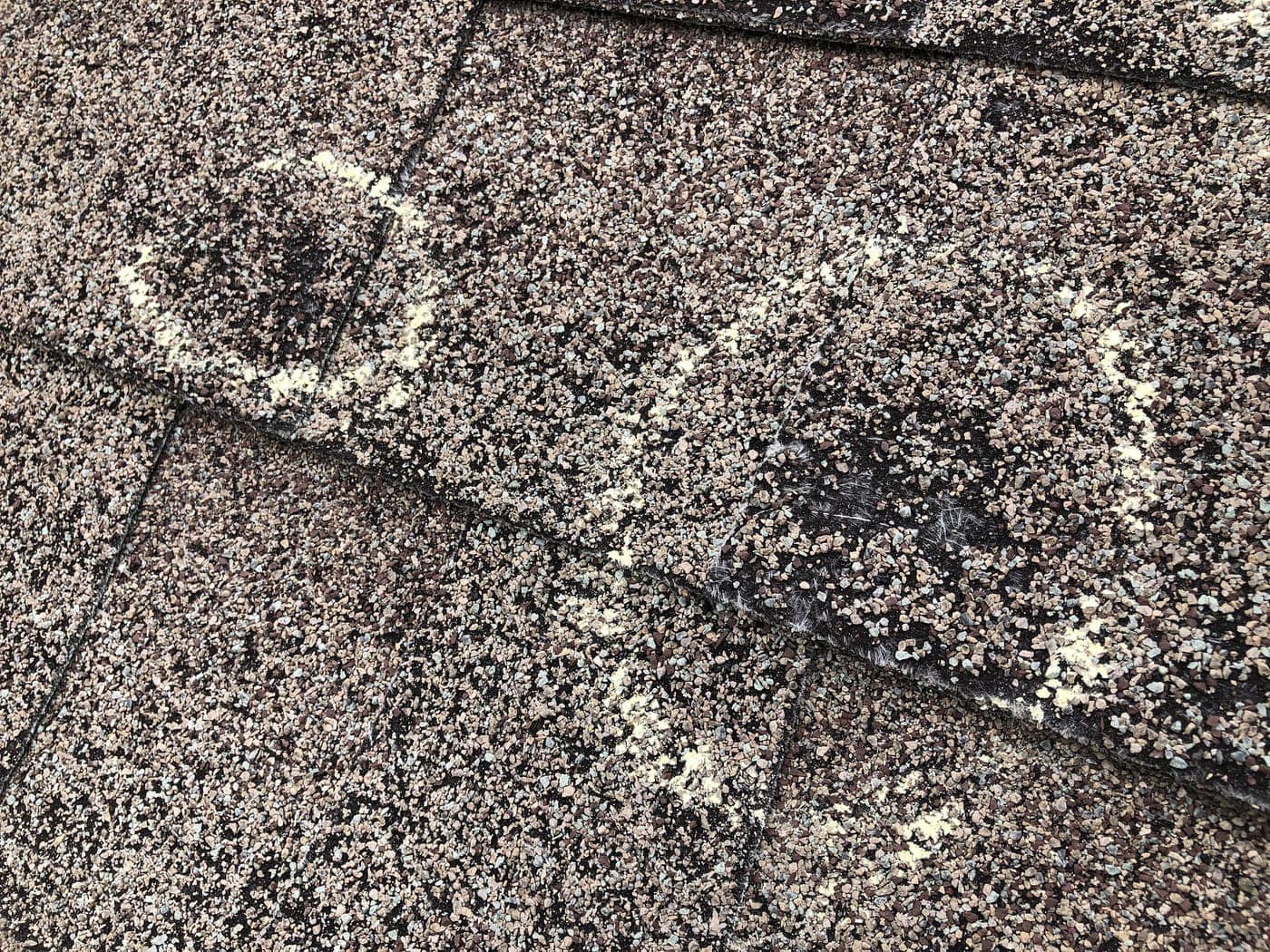
Granules gone, mat exposed. Photo courtesy of Continental Roofing Company.
The claim, step by step
April 4 — I opened the claim.
April 20 — The carrier sent a third-party inspection firm. No contractor of mine was present — a mistake I'll come back to.
April 26 — The adjuster called: the inspection found absolutely no hail damage. Not "below threshold," not "cosmetic only" — none.
May 1 — Following the standard playbook, I requested three things: a reinspection, a copy of the inspection report, and a different adjuster. The answers were no, no, and no. I was told the carrier doesn't do second inspections, doesn't share its reports, and doesn't reassign adjusters. My only option, I was told, was a "supplement" — submit my own photos and hope.
May 3–15 — So I did, twice over. One contractor emailed the carrier its full photo set — thirty-five chalk-marked photos, with a note that it seemed odd the claim wasn't approved given what was on the roof. A second contractor flew a drone inspection and I submitted that set too.
May 19 — The adjuster called with a remarkable reversal: the first inspection's photos had been taken "too far away," he could see hail damage in the photos I'd submitted, and the carrier would like to do a second inspection — the thing I'd been told, three weeks earlier, they never do.
June 2 — A different inspection firm spent about half an hour on the roof.
A few days later — The result: absolutely no hail damage. Again. The same adjuster who had seen damage in my photos now relayed a second report finding none. The claim moved toward closure, and I was sent a customer satisfaction survey. I answered it honestly.
Days later — The carrier called: a new adjuster would review the claim. (Also a thing I'd been told doesn't happen.)
June 11 — The new adjuster's answer: the denial stands. I filed a complaint with the Alabama Department of Insurance the same day, laying out everything above.
The complaint forced a formal response and put the contradictions on the record. It did not change the outcome. The denial stood.
As of this writing, the roof still hasn't been replaced. When it is, it will be on my own dime.
What this experience actually teaches
Be at the first inspection, with your contractor. Every fork in this road traces back to April 20, when the carrier's inspector walked my roof alone. My contractor's chalk marks were already up there — 44 hits in five feet — and there was nobody present to point at them. By the time my photos "showed damage," I was arguing against a report I wasn't allowed to read. The inspection is the claim; treat it that way.
Get every "we don't do that" in writing. I was told no second inspections, no report copies, no adjuster changes. Two of those three turned out to be untrue within six weeks — the second inspection happened, and so did the adjuster change. If those statements had only ever existed as phone calls I hadn't noted, the contradiction would have been my word against theirs. Date-stamped notes made it a documented pattern instead.
The squeaky wheel is real, but it has limits. A negative survey response got my claim a new set of eyes in three days after six weeks of stonewalling. Escalation pressure works — right up until it doesn't. Three contractors, two photo submissions, one state complaint: the machine absorbed all of it and produced the same answer.
A state complaint builds the record; it doesn't flip the verdict. I'd still file it again, earlier — it's free, it forces a formal response, and if a dispute ever reaches an attorney, that file is gold. But nobody should file one believing it's the boss level where the claim gets approved.
Know your remaining moves before you're exhausted. By the time the denial was upheld, I had spent three months on this. The options that remain at that point — appraisal (where the policy allows it), a public adjuster, an attorney reviewing the handling — all take energy, and the legal clock keeps running regardless of how tired you are. Decide your stopping point deliberately, not by attrition.
The carrier you choose matters more than the premium. This is the lesson I'd shout from my chalk-marked roof. Rates and deductibles are easy to compare; how a company behaves when you actually file a claim is the thing that matters, and you only discover it when it's too late to switch. It is knowable in advance, though: local independent agents work with many carriers and see, claim after claim, which ones resolve hail damage fairly in your area and which ones fight — ask them that question directly before you buy. State insurance departments also publish complaint statistics by carrier. When it's time to shop your coverage, weigh claim reputation at least as heavily as price. I certainly do now.
Why this site exists
I built this site because of that spring. Not because knowing the process guarantees you'll win — my own file proves it doesn't — but because at every step, the difference between being steamrolled and putting up a documented fight was information I had to dig for while angry, confused, and on a deadline. That information should be free and in plain English. Now it is.
If you're at the beginning of this road: document everything, get your contractor to the inspection, and know the appeal ladder before you need it. If you're at the end of it, staring at an upheld denial: I've been exactly where you are, and whatever you decide — escalate, or make peace and re-roof on your own terms — make it a decision, not a default.
Go deeper
Claim Denied? How to Read the Letter and AppealCommon reasons roof claims get denied, how to request a reinspection, how to write a rebuttal, the appraisal clause, and when to file a state complaint.
Not sure where your claim stands?
Describe the damage once and local roofing contractors can inspect it and give you an estimate.
Frequently asked questions
Often they'll try, and whether you can force the issue varies by state. In my case, the carrier refused outright. What you can always do is demand the specific basis for the denial in writing — carriers are generally required to state their reasons — and a state insurance department complaint can sometimes pry loose documentation that a phone call can't. Ask early, in writing, and keep the refusal in your records; it becomes part of your paper trail.